Use this guide to understand application review and payment setup. For requests you can copy, follow the merchant onboarding guide. For diagrams and suggested messages, see merchant experience flows.
The complete hosted flow has six steps:
- Register a merchant webhook and store its signing secret on your server.
- Create a merchant and keep the returned merchant ID.
- Create an onboarding link for that merchant.
- Sign the merchant in to your app, then open the returned URL so they can complete and sign the application.
- On return, read the current merchant and show progress.
- Follow webhook updates through KYC and payment setup. Use
merchant.payments_onboardedfor completed payment setup.
Creating a merchant alone doesn't submit an application. See the complete sequence diagram for the handoff between your app, the API and hosted onboarding.
Payments API in progress. You can track payment setup status. Endpoints for taking payments, refunds and charges are not published yet.
Before a merchant can take payments, TalusPay verifies the business and its owners. This check is called KYC (know your customer). It starts on its own once the application is signed: there is no endpoint to call.
The merchant has two statuses:
lead_onboarding_status: where the application stands, including the KYC decision.payment_onboarding_status: whether the merchant is set up to take payments. This step runs after KYC approves the merchant.
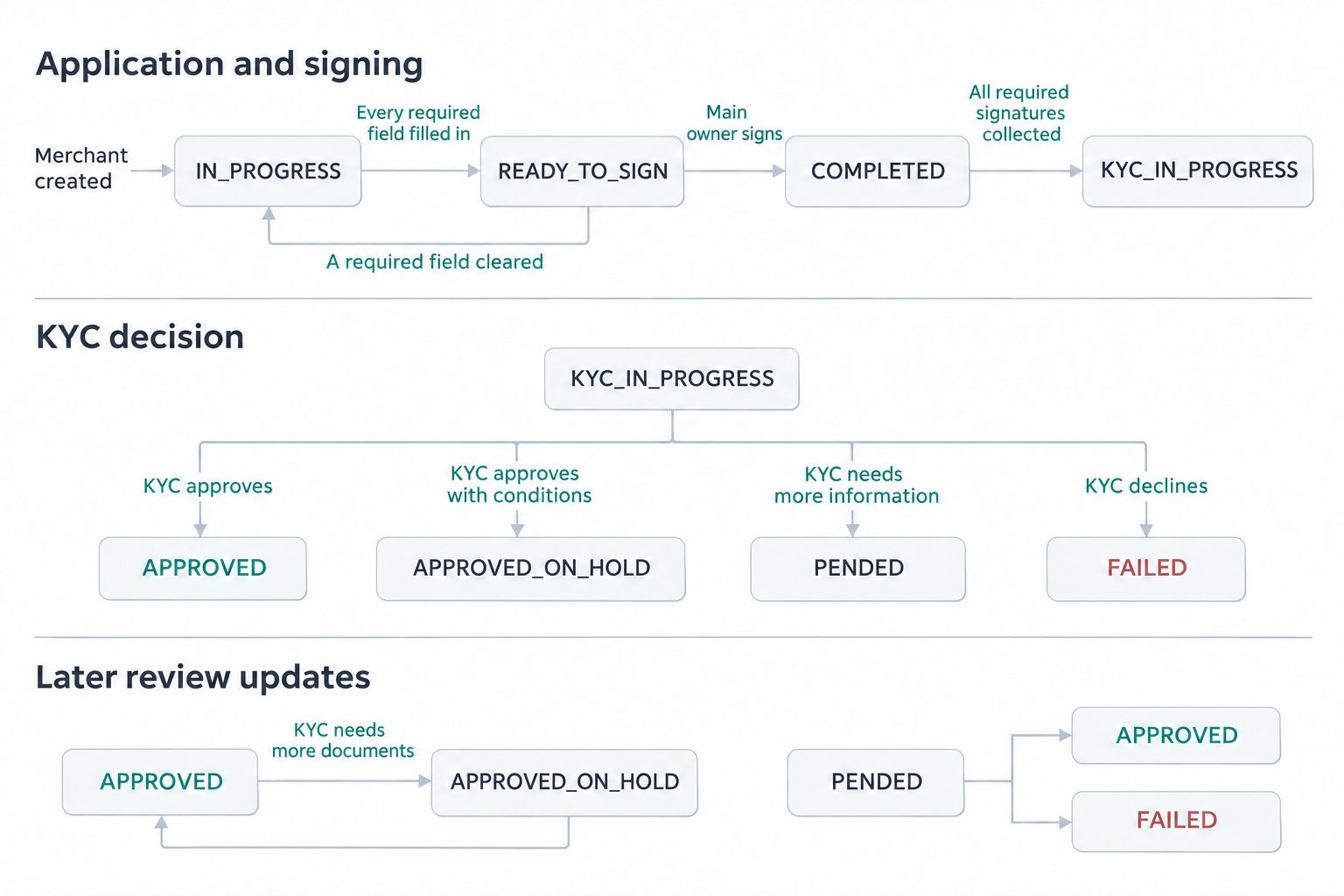
lead_onboarding_status | Meaning |
|---|---|
IN_PROGRESS | The merchant is filling in the application, or hasn't started it. Every merchant starts here. |
READY_TO_SIGN | Every required field is filled in. The application waits for the main owner to sign. |
COMPLETED | Main owner signed; awaiting remaining signatures or KYC initiation. |
While the merchant is IN_PROGRESS or READY_TO_SIGN, each change to the application moves it between the two. From COMPLETED on, the application can't be changed: an update returns LEAD_DATA_LOCKED.
Once every required signer has signed, the application is sent to KYC automatically and lead_onboarding_status becomes KYC_IN_PROGRESS. It stays there until KYC decides.
lead_onboarding_status | Meaning | Webhook | Payments |
|---|---|---|---|
APPROVED | The merchant is approved. | merchant.kyc_approved | Set up next, see step 5. |
APPROVED_ON_HOLD | The merchant is approved, but KYC needs more documents or is still reviewing them. | merchant.updated | Set up next, see step 5. |
PENDED | KYC needs more information before it can decide. | merchant.updated | Blocked until KYC approves. |
FAILED | KYC declined the merchant, or onboarding failed. | merchant.verification_failed | Not set up. |
No dedicated event is sent when KYC puts a merchant on hold or pends it: you only receive merchant.updated. Check lead_onboarding_status in its payload, or read the merchant with GET /v1/merchants/{merchant_id}. The moves to READY_TO_SIGN, COMPLETED and KYC_IN_PROGRESS send no event: read the merchant when it comes back.
The status can still change after approval. For example, KYC can put an approved merchant on hold if it needs more documents. Read the current status before you rely on it.
Read the merchant with GET /v1/merchants/{merchant_id}?expand=approval_status to get the KYC details:
approval_status | Meaning | What to do |
|---|---|---|
APPROVED | Approved. Nothing is missing. | Nothing. |
APPROVED_WITH_REVIEW | Approved, but the merchant must send more information. | Open status_review_url. |
APPROVED_UNDER_REVIEW | Approved. The merchant has sent the information and KYC is reviewing it. | Wait. |
PENDED_ACTION_REQUIRED | Payments are blocked until the merchant sends more information. | Open status_review_url. |
PENDED_UNDER_REVIEW | Payments are blocked while KYC reviews what the merchant sent. | Wait. |
DECLINED | KYC declined the merchant. | Nothing. The decision is final. |
status_review_url is a page where the merchant sees what KYC needs, sends it, and follows the review. Open it in a browser or a webview. It is set for the four review states above, including the *_UNDER_REVIEW ones, and null for APPROVED and DECLINED.
approval_status is left out until the application is submitted (COMPLETED or later). It can also be left out of a submitted application while KYC has no decision yet, or when the KYC provider can't be reached: treat a missing value as "still in review" and check again later. Each request asks the KYC provider live, so it is slower than a plain read: request it only when you need it, and don't poll it in a tight loop.
Once the merchant is APPROVED or APPROVED_ON_HOLD, TalusPay sets it up to take payments:
payment_onboarding_status | Meaning | Webhook |
|---|---|---|
NOT_STARTED | Payments are not set up yet. | None |
ONBOARDED | Payment setup is complete. | merchant.payments_onboarded (and merchant.verification_approved) |
FAILED | Setting up payments failed. | merchant.payments_onboarding_failed |
A failed payment setup does not undo the KYC approval. Show the payment setup failure separately from the application status; don't send the merchant through the application again.
The public API and merchant webhooks report setup status without returning payment gateway credentials.
When kyc_handled_by_partner is true on the merchant, your account's partner program reviews applications itself. TalusPay does not send these merchants to KYC.
- Subscribe a webhook to the
merchantscope. - On
merchant.kyc_approved, tell the merchant they are approved. - On
merchant.payments_onboarded, show that payment setup is complete. If the event is missed, read the merchant's currentpayment_onboarding_status. - On
merchant.verification_failed, check the current merchant and available review outcome before showing a decline: the event can also mean onboarding failed. - While a merchant is
COMPLETED,KYC_IN_PROGRESS,APPROVED_ON_HOLDorPENDED, check it from time to time withexpand=approval_status, and showstatus_review_urlwhen the merchant has to act. Show a waiting message for*_UNDER_REVIEWstates. See suggested merchant messages.
In sandbox, POST /v1/events/trigger lets you skip the real review. Send merchant.verification_approved to approve a merchant or merchant.verification_failed to decline it. Both send the matching webhooks, so you can test your integration end to end. They do nothing in production. See Testing.